After trying multiple medications with little relief, many people turn to TMS Therapy for depression—a non-drug treatment option for treatment-resistant depression. If antidepressants left you feeling numb, exhausted, or unchanged, there may still be another path forward.

Meaningful clinical response rate in adults with treatment-resistant depression after a full course of TMS therapy

Full remission rate, meaning symptoms no longer meet the criteria for major depressive disorder
Typical length of a full TMS treatment course, with sessions 5 days per week
Length of a standard TMS session. No setup time, no recovery room.
When standard medications don’t work, depression often settles into specific patterns. The table below outlines common symptom domains and how they tend to impact daily function in adults.
Symptom Domain
Persistent low mood
Loss of interest (anhedonia)
Fatigue and low energy
Poor concentration and brain fog
Sleep problems
Motivation issues
Emotional numbness
Hopelessness
Common impact on daily life
Feeling heavy or flat most of the day, nearly every day. Difficulty accessing positive emotions even during good news.
Former hobbies feel like chores. Social invitations become stressors. Sex drive drops sharply.
Showering feels like a project. Afternoon crashes that caffeine doesn’t touch.
Reading the same paragraph three times. Forgetting appointments. Struggling to follow conversations.
Either can’t fall asleep or can’t get out of bed. Waking at 3 AM with racing thoughts is common.
Tasks pile up because starting them requires a level of energy that isn’t there.
Not exactly sad—more like nothing. Flat affect that others mistake for not caring.
The quiet belief that nothing will help. This is why treatment resistance is dangerous: hope erodes first.
TMS is not a one-time procedure. It is a scheduled course of treatment, similar to physical therapy for the brain.
Call (775) 507-2606. No cost. No commitment. A staff member will ask about your depression history, what you have tried, and whether TMS is worth exploring
You meet with Nickolas Culpepper, M.D. (board-certified psychiatrist) or one of our physician assistants. They will confirm your diagnosis of major depressive disorder, document medication failures, screen for contraindications (metal implants in the head, seizure history, certain neurological conditions), and answer your specific questions.
This is the setup session, about 90 minutes. The clinician finds the minimum magnetic energy needed to produce a small response in your hand muscles. That number becomes your treatment dose. They also measure your head to mark the exact coil position for every future session.
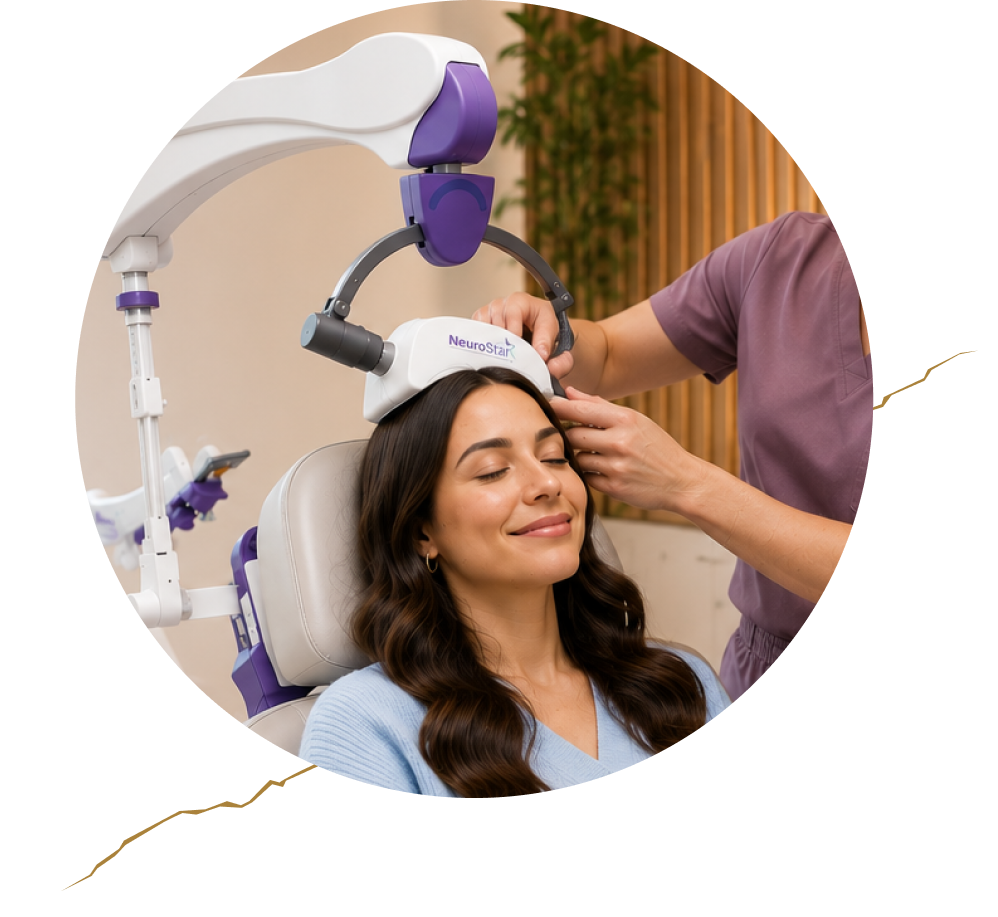
You sit in a reclining chair, awake and alert. The coil taps against your scalp. Each session runs 19 to 37 minutes. You will hear clicking sounds and feel a tapping sensation on the side of your head. Most patients read, scroll their phone, or just close their eyes. When the session ends, you walk out and go back to your day.
No anesthesia. No sedation. No driving restrictions. You can go straight to work, pick up your kids, or meet a friend for coffee. The only after-effect some people notice is a mild headache, which usually responds to over-the-counter medication.
A full course is typically 20 to 30 sessions, scheduled once daily, Monday through Friday, for 4 to 6 weeks.Some patients who respond well opt for a maintenance schedule afterward — typically one session weekly or biweekly — to prevent relapse. Your psychiatrist will track your progress and recommend a maintenance plan if needed.
Feature
Invasiveness
Works after medication failure
Systemic side effects
Time to effect
Treatment schedule
Recovery time
Can you drive your self?
Insurance coverage
TMS Therapy
Non-invasive, no anesthesia
Yes (FDA-cleared for treatment-resistant depression)
None (no weight gain, sexual dysfunction, nausea)
2-4 weeks to early signs, full effect by week 6
Daily for 4-6 weeks
None (return to work same day)
Yes
Most major plans (with prior authorization)
Antidepressants
(SSRIs/SNRIs)
Systemic (oral medication)
No (switching meds has diminishing returns)
Weight gain, sexual dysfunction, emotional blunting, fatigue
4-8 weeks
Daily (ongoing)
Variable
Yes
Routinely covered
Psychotherapy (CBT)
Non-invasive
Yes, but engagement is hard when severely depressed
None
8-12 weeks
Weekly for 12-20 weeks
None
Yes
Routinely covered
Electroconvulsive
Therapy (ECT
Invasive, requires general anesthesia
Yes
Memory loss, cognitive confusion, muscle soreness
1-2 weeks
2-3 times per week for 3-4 weeks
1-2 hours in recovery room
No (required after ECT)
Covered for severe refractory cases

“I had been on antidepressants since college. Lexapro made me gain 40 pounds. Wellbutrin made me anxious. Trintellix did nothing. I was sure nothing would ever help. By the third week of TMS at Sugi, I noticed I was singing along to music in the car. I had not done that in years. Dr. Culpepper was honest about what to expect, and the staff made every session easy. That was 14 months ago. I am still stable.”
“The brain fog was the worst part. I could not finish a work email. I felt stupid. My PA, Jacob, explained exactly how TMS targets the circuits involved in concentration. After about 15 sessions, I noticed I was reading again. Actual books. The fog lifted so slowly I almost did not notice until one day I realized I had worked for four hours straight without getting lost.”
“I was terrified of ECT but I also could not keep living the way I was. My primary care doctor mentioned TMS as ‘something in between.’ It is not in between. It is its own thing. No sedation. No memory loss. Just 19 minutes in a chair. I brought my laptop and answered emails during treatment. By week five, my husband said I laughed at something for the first time in a year. That sounds small. It was not small.”
Coverage for transcranial magnetic stimulation has improved significantly over the past five years. Most major insurers now recognize TMS as a standard treatment for treatment-resistant depression, not an experimental option.
Typical coverage criteria you will need to meet:
Confirmed diagnosis of major depressive disorder (single or recurrent episode)
Documented failure of at least one, usually two, antidepressant trials at adequate dose and duration
No contraindications (metal implants in the head, seizure disorder, certain neurological conditions)
Some insurers also require documentation that you are engaged in concurrent psychotherapy
Insurers that commonly cover TMS:
Aetna (prior authorization required, documented treatment resistance needed)
Anthem Blue Cross Blue Shield (Nevada plans increasingly cover TMS)
Cigna (case-by-case, but routinely approved with proper documentation)
UnitedHealthcare / Optum (requires documented failure of two antidepressants)
TRICARE (coverage varies; pre-authorization required)
Most commercial PPO plans (your specific plan may require advocacy and an appeal)
Clinically, it means you have tried at least one antidepressant at an adequate dose (typically the therapeutic range or higher) for an adequate duration (usually 6-8 weeks) and your symptoms did not meaningfully improve. Some definitions also include intolerance to side effects that prevent continued treatment. Dr. Culpepper will formally assess this during your psychiatric evaluation.
Most people describe a tapping or knocking sensation on the scalp. Some find it mildly uncomfortable at first. The sensation typically becomes less noticeable after the first few sessions as you habituate to it. You can stop the treatment immediately at any time by raising your hand.
Yes. Most patients remain on their antidepressant during TMS. The treatment does not interact with medication because it is not a drug. Some patients eventually reduce or discontinue medication after completing TMS, but that decision is made carefully with your psychiatrist.
Some early signs—improved sleep, slightly more energy, less brain fog—can appear by week two. The full effect usually takes the entire 4- to 6-week course. Do not expect overnight change. Expect gradual, week-by-week lifting.
Response rates are good but not perfect. About 40-50% of patients with treatment-resistant depression do not achieve a meaningful response. If you are in that group, your psychiatrist will discuss other options: medication adjustment, ECT (for severe cases), or investigational protocols. We do not abandon you if the first treatment does not work.
TMS is FDA-cleared for major depressive disorder, not bipolar depression. In people with bipolar disorder, brain stimulation may trigger a switch into mania or hypomania. That does not mean TMS is never used—it means it requires careful screening and monitoring. Dr. Culpepper will assess your full history before recommending TMS.
The NeuroStar system is FDA-cleared for adolescents aged 15 and older with treatment-resistant depression. Sugi Psychiatry & Wellness primarily treats adults, but we can discuss adolescent (15+) cases on an individual basis. Call to ask.
A standard course is 20 to 30 sessions, delivered once daily, Monday through Friday. Some patients respond earlier and stop at 20. Others need the full 30. Your psychiatrist will track your symptom scores weekly and make a data-driven decision about when to stop.
No. You can contact us directly. We will request your prior medical records (including medication history) as part of the psychiatric evaluation.
Please provide 24 hours’ notice for session cancellations or rescheduling. Missed appointments or late cancellations may incur a fee, because we hold that time specifically for you.